

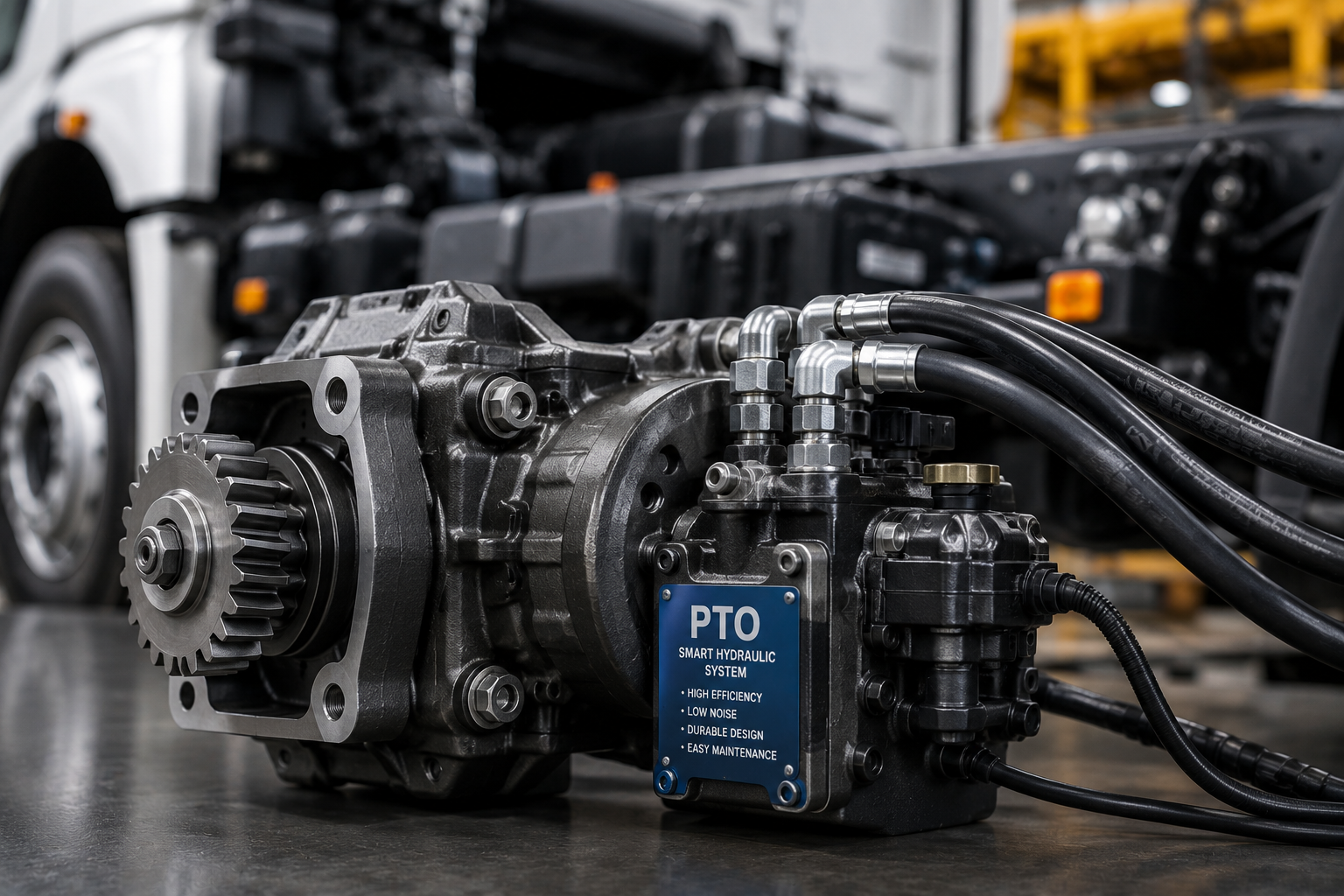

To understand the innovation clearly, we first need to answer what is a pto? in a practical way: a Power Take Off system transfers power from a truck’s engine, transmission or driveline to auxiliary equipment, and in hydraulic applications that power usually drives a pump so oil flow can move cylinders, motors, cranes, tail lifts, tippers, refuse compactors, fire pumps or other vehicle body functions. Sources such as Geotab describe PTOs as mechanisms that transfer vehicle engine power to auxiliary equipment such as hydraulic lifts and pumps, while Parker presents modern ePTO technology as a ready to install hydraulic power solution for battery electric and hybrid commercial vehicles, and this tells us that the PTO world is expanding from mechanical strength into intelligent energy management. For a manufacturer such as Özcihan Makina, this evolution creates a clear opportunity to connect proven heavy duty power transmission knowledge with the changing needs of modern truck platforms.
Hydraulic PTO Units Are Becoming Smarter
Hydraulic PTO units used to be judged mostly by whether they fit the transmission, delivered enough torque and rotated the pump at the required speed, but modern truck applications now demand much more than simple rotation. A construction vehicle may need fast and reliable dump body operation, a refuse truck may need repetitive hydraulic cycles throughout a long urban route, a utility truck may need precise control for an aerial lift, a fire truck may need dependable pump performance, and an electric vocational truck may need auxiliary hydraulic power without relying on engine idle. In each case, the PTO must work as part of a complete hydraulic ecosystem, and that ecosystem includes truck pto models, pumps, shafts, valves, couplings, brackets, electronic controls, telematics data and service planning.

I like to compare a modern hydraulic PTO unit to the heart of a working truck, because the PTO starts the pulse, the pump circulates the oil, the valves direct movement, and the body equipment performs the physical work that customers actually pay for. If the heart beats too fast, too weakly or at the wrong rhythm, the whole body struggles, and that is why innovation today focuses not only on stronger components but also on better matching, better monitoring and better control. In this sense, hydraulic PTO innovation is not about adding complexity for show; it is about making the truck feel more natural, more responsive and more efficient during real work.
Innovation 1: Electric PTO and High Voltage Hydraulic Power
The biggest innovation in hydraulic PTO units is the rise of electric PTO, often called ePTO, because battery electric and hybrid commercial vehicles need a way to power hydraulic equipment without a conventional engine driven PTO. Parker’s ePTO H075 documentation describes a high voltage electric power take off system that provides 75 kW peak hydraulic power with more than 80 percent energy transfer efficiency for battery electric and hybrid commercial vehicles, including refuse haulers, dump trucks, utility fleets and aerial lift applications, and this example shows how quickly hydraulic PTO thinking is adapting to new truck architectures. The SAE J3253 recommended practice, published in 2025, also covers general guidelines for conductive high voltage DC power transfer between commercial vehicle chassis electrical systems and body accessory equipment, which signals that the industry is creating more structured interfaces for electric auxiliary power.

This trend does not mean traditional hydraulic PTOs will disappear, because diesel and conventional heavy duty trucks will continue working in construction, logistics, municipal and emergency fleets for many years, yet it does mean future ready manufacturers and body builders must understand both mechanical and electric power paths. A diesel truck may still use a transmission PTO connected directly to a pump, while an electric refuse truck may use high voltage electrical energy to drive a hydraulic power pack, and both vehicles still need practical hydraulic force at the working equipment. The technology changes, but the customer’s expectation remains beautifully simple: the equipment must work reliably when the operator needs it.
Innovation 2: Better Pump Matching for Higher Efficiency
Another important innovation is better pump matching, because a hydraulic PTO unit is only as efficient as the pump and load profile connected to it. When the PTO output speed, torque capacity and duty cycle match hydraulic pump models correctly, the truck can operate with less heat, smoother response and better component life, while poor matching can create noise, overheating, slow equipment movement and unnecessary wear. In simple applications, gear pump models may provide dependable flow for lifting or tipping operations, while more demanding systems may use piston pump models where higher performance, pressure control or efficiency is required.

Modern innovation here is not only about choosing a bigger pump; in fact, choosing the biggest pump without understanding the real duty cycle can create the opposite of efficiency. The smarter approach is to calculate the required flow, pressure, operating time, oil temperature, engine speed or electric power availability, then select the PTO and pump as one coordinated pair. I see this like choosing a pair of lungs for the truck’s hydraulic body; the system needs enough breathing capacity for the work, but it also needs the right rhythm so it does not waste energy with every cycle.
| Innovation Area | What Is Changing | Why It Matters for Modern Trucks | Practical Benefit |
|---|---|---|---|
| ePTO integration | High voltage electric power drives hydraulic systems on electric and hybrid trucks | Battery electric vehicles need auxiliary power without engine driven PTO architecture | Lower local emissions, less idle noise and better electric truck compatibility |
| Smart pump matching | PTO ratio, torque and pump demand are selected together | Hydraulic systems perform better when power supply matches real duty cycle | Less heat, smoother operation and longer component life |
| Telematics monitoring | PTO engagement and operating time can be tracked in fleet systems | Managers can see actual auxiliary equipment use, not only mileage | Better preventive maintenance and reduced misuse |
| Compact modular design | Integrated hydraulic power packs and easier mounting layouts reduce installation complexity | Body builders need faster installation and cleaner vehicle integration | Shorter build time and easier service access |
| Improved control and safety | Electronic signals, interlocks and smoother engagement support safer operation | Modern trucks operate around people, equipment and tight working spaces | More predictable movement and stronger operator confidence |
Innovation 3: Telematics Makes PTO Work Visible
One of the most practical developments in modern truck PTO systems is the ability to monitor PTO engagement through telematics, because fleet managers increasingly want to know not only where a truck traveled, but also how long it worked through its auxiliary equipment. Geotab explains that PTO status can be monitored through vehicle data, helping fleets understand PTO use and identify patterns that may indicate misuse, excessive wear or inefficient operation. This matters because a truck may show low mileage but high PTO hours, especially in refuse collection, utility service, road maintenance, fire support or urban delivery work, and if maintenance planning ignores PTO working hours, the fleet sees only half of the vehicle’s life story.

I find this change very valuable because it gives the PTO a voice. For decades, the PTO worked silently under the truck, and maintenance teams often relied on driver comments, visible leaks, noise or failure symptoms, yet connected monitoring allows the system to speak earlier through data. When fleet managers can see how often PTOs are engaged, whether vehicles move during PTO operation, how long hydraulic cycles last and which vehicles show unusual patterns, they can train operators better, schedule maintenance smarter and reduce expensive downtime. For Özcihan Makina, this trend supports a broader product philosophy where strong mechanical components become even more valuable when fleets use them with better operating intelligence.
Innovation 4: Compact, Modular and Easier to Integrate Units
Modern truck builders want hydraulic PTO systems that are easier to install, easier to service and easier to package around increasingly crowded chassis layouts. Emission systems, battery packs, frame mounted equipment, safety components and body builder accessories all compete for space, so compact and modular design has become a real innovation area. Parker’s electric truck case study describes an ePTO concept that converts high voltage DC power from the truck into controllable hydraulic power and reduces guesswork for the manufacturer or third party integrator, which captures the direction of the market very well: body builders want solutions that arrive as predictable systems rather than loose collections of parts.

That same idea also applies to conventional hydraulic PTO units, because a cleaner installation can reduce hose stress, improve pump support, simplify service access and lower the chance of vibration related problems. Supporting components such as couplings models and cardan shafts models become part of this integration story, because even the most advanced hydraulic PTO idea needs stable mechanical connections and proper alignment to deliver real reliability in the field.
Innovation 5: Split Shaft Solutions for Demanding Truck Bodies
While ePTO systems are getting attention, demanding mechanical applications still create strong demand for robust driveline based power transfer, especially in vehicles that need higher auxiliary output or special operating layouts. split shaft pto models remain important for vehicles such as sewer cleaning trucks, vacuum tankers, fire trucks, road service vehicles and other special purpose heavy duty platforms where a standard side mounted PTO may not provide the most suitable power path. In these applications, innovation often means stronger housings, better gear design, improved sealing, smoother engagement, more application specific ratios and better coordination with pumps and shafts.

A split shaft hydraulic PTO solution is like creating a carefully controlled junction in the truck’s power highway, because the driveline carries energy forward and the PTO redirects a useful portion of that energy toward work equipment. If the junction is designed well, power flows smoothly; if the layout is poorly matched, the system can suffer from vibration, heat, wear or difficult operation. This is why application experience matters so much, and why Özcihan Makina fits naturally into the discussion of modern hydraulic PTO innovation, because heavy duty truck body builders need components that respect the full power path rather than only the individual gearbox.
Innovation 6: Smarter Hydraulic Control with Valves and Electronics
Hydraulic innovation is not only about the PTO and pump; it is also about how oil flow is controlled after the pump starts working. Modern trucks increasingly need smoother movement, safer operation, operator friendly controls and more predictable equipment behavior, especially in vehicles such as crane trucks, aerial lifts, refuse collectors, emergency vehicles and construction support trucks. This is where valves models matter deeply, because a hydraulic system with poor control can waste the advantages of a strong PTO and a well selected pump.

Modern control can include better valve selection, safer engagement logic, speed regulation, pressure protection, load sensing behavior and integration with electronic control panels. I like to compare this to steering a powerful horse; strength is useful only when control is calm and precise. A hydraulic PTO unit may provide excellent power, but the working body must move in a way that feels safe and predictable for the operator, especially when the truck works around people, buildings, traffic or emergency conditions.
Innovation 7: Reliability Focused Maintenance and Pump Support
Another important innovation is not glamorous, but it is extremely practical: better maintenance design. Modern hydraulic PTO systems increasingly focus on pump support, spline lubrication, bracket design, leak control, easier inspection and clearer service intervals, because long term reliability depends on details that may look small during installation. Parker Chelsea owner guidance has historically emphasized supporting heavy or long pump installations with brackets and paying attention to pump flange lubrication, which is a reminder that hydraulic PTO reliability often depends on how well the PTO, pump and mounting structure live together under vibration.

This is where reducer models and related support components also enter the conversation, because modern truck systems may need speed adaptation, torque management or different mechanical layouts to suit the body equipment. In my view, innovation that makes maintenance easier is just as important as innovation that increases peak power, because fleets do not measure success only during the first demonstration; they measure it across years of dusty, cold, hot, rushed and repetitive daily work.
Hydraulic PTO Innovation in Emergency and Municipal Trucks
Emergency and municipal trucks show the human side of hydraulic PTO innovation very clearly 🚒. A fire truck, road maintenance unit, water tanker or municipal cleaning vehicle may rely on PTO driven equipment during important public service work, and in those moments reliability is not an abstract engineering term; it becomes confidence for the operator and service quality for the community. Products such as fire fighting water pump models reveal how PTO based hydraulic and mechanical power can support critical applications where water movement, pressure stability and rapid response matter.
-212781031195243.png)
In these vehicles, innovation may appear as smoother pump drive, cleaner installation, better shaft alignment, improved control, easier inspection access or reduced idle behavior. None of these improvements needs to look dramatic from outside the truck, yet together they can reduce stress for operators and improve readiness. That is the beauty of good engineering: the best innovations often feel quiet because everything simply works.
A Practical Example: Modern Hydraulic PTO on an Electric Utility Truck
Let us imagine a modern electric utility truck with an aerial lift working in a city neighborhood 😊. In an older diesel configuration, the truck might rely on engine driven PTO power and extended idle time to operate the hydraulic lift, yet a newer electric architecture can use an ePTO or electric hydraulic power unit to convert high voltage battery energy into controlled hydraulic power for the lift. The technician still needs smooth boom movement, safe control, reliable pressure and predictable runtime, but the truck can now reduce local emissions and operate with lower noise, which matters in residential areas, night work and city service routes. This example shows why hydraulic PTO innovation is not only about trucks becoming more advanced; it is about work becoming cleaner, quieter and more comfortable for the people around it.

The same logic can apply to refuse vehicles, dump trucks, delivery bodies, tanker systems and emergency service platforms, because every modern truck body asks a similar question: how can we get the power we need with less waste, less noise, better control and stronger reliability? A good hydraulic PTO solution answers that question by combining the correct power source, correct pump, correct control, correct installation and correct service culture.
Key Insights for Fleet Owners and Body Builders
The first key insight is that hydraulic PTO innovation is moving in two directions at once: traditional mechanical systems are becoming more refined, while electric and hybrid trucks are creating space for high voltage ePTO solutions. The second insight is that pump matching matters more than ever, because efficiency and reliability depend on selecting the PTO and pump around the actual duty cycle. The third insight is that telematics can make PTO use visible, helping fleets plan maintenance based on real auxiliary work rather than only mileage. The fourth insight is that compact, modular designs can reduce installation complexity and help body builders work around crowded modern chassis layouts. The fifth insight is that Özcihan Makina remains relevant in this changing environment because hydraulic PTO innovation still needs durable power transmission components, application understanding and reliable manufacturing quality.

Conclusion: The Hydraulic PTO Is Becoming a Smarter Power Partner
Innovations in hydraulic PTO units for modern trucks show that the future of auxiliary power will be more flexible, more connected and more efficiency focused than ever before. Mechanical PTOs will continue to serve heavy duty fleets because they are practical, proven and powerful, yet ePTO systems will grow as electric and hybrid commercial vehicles expand, especially in urban service, refuse collection, utility and specialized vocational applications. At the same time, better pump matching, telematics monitoring, compact installation, smarter valve control and maintenance friendly design will help fleets get more value from every truck.

In the end, I see the modern hydraulic PTO unit as more than a mechanical component; I see it as a power partner that helps the truck translate stored energy into useful work with intelligence and confidence 🚚. The best systems will not be the ones that simply claim the highest output, but the ones that match the vehicle, the pump, the operator, the duty cycle and the future direction of the fleet. For body builders and fleet owners looking for durable and practical power transmission solutions, this is exactly why Özcihan Makina belongs in conversations about modern hydraulic PTO innovation, because real progress happens when strong mechanical engineering meets smarter, cleaner and more connected truck technology.

