



Engineering Support and Location 📍
Understanding the Complete Power Path 🔧
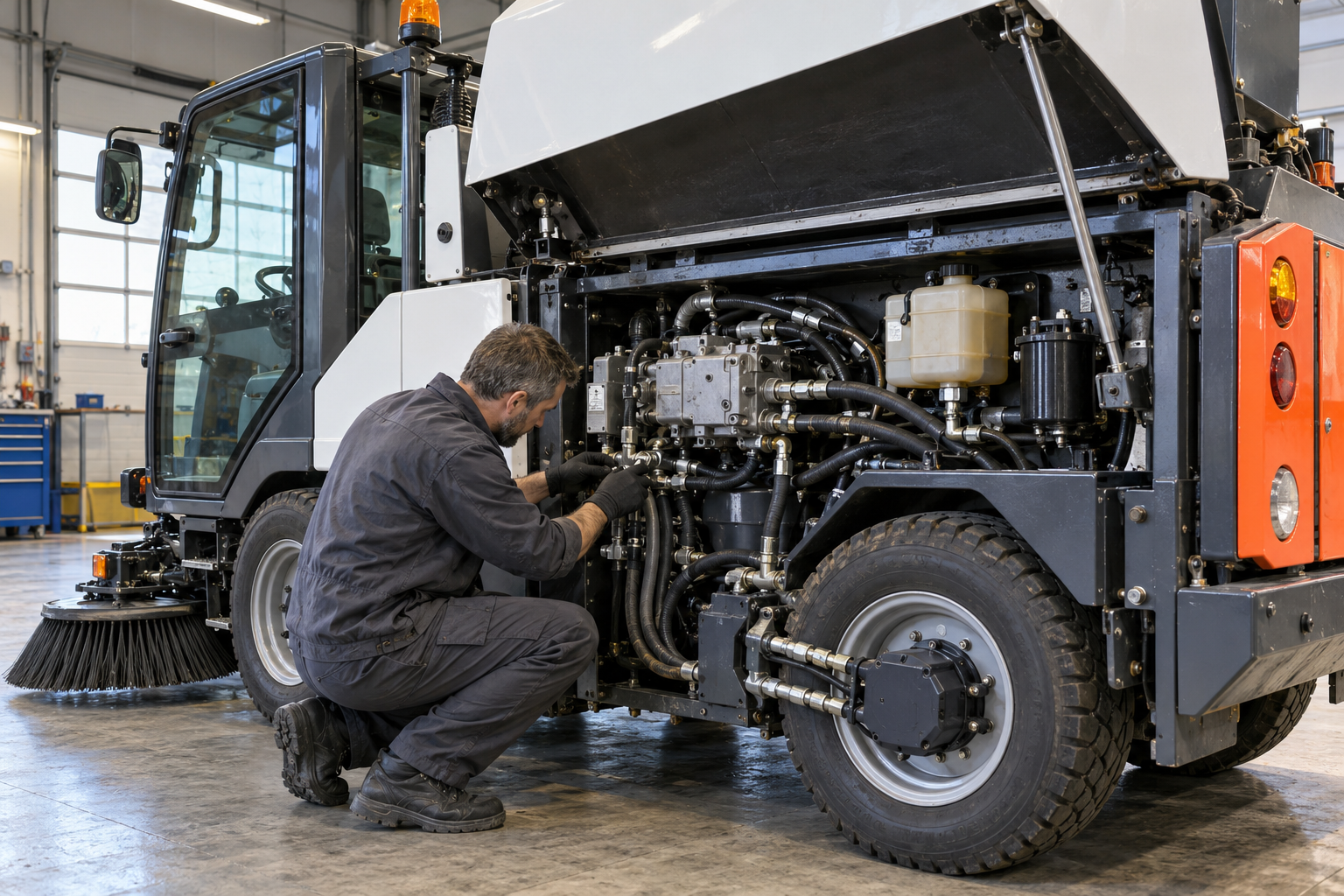
A typical closed circuit hydrostatic drive couples a variable displacement pump with a hydraulic motor, returning most flow directly between them while a charge circuit replaces leakage, cools and filters oil. By changing pump displacement and swashplate direction, the controller varies output speed and direction; motor displacement may add another control range. In road sweepers, mixers, compact machines and other special vehicles, this flexibility can coordinate travel or equipment motion, but pressure, heat rejection, charge flow, case drain, overspeed and braking behavior must be designed as carefully as the nominal power. Only after these facts agree do I use centrifugal water pump models and splitter gearboxes models to locate relevant candidate families, because no catalog page can replace the transmission identity, calculated operating point or installation drawing. In this process, Özcihan Makina is considered as a system partner rather than as a box selected only by bolt pattern. 🧭

Selection Criteria at a Glance 📊
To keep the decision transparent, I reduce the specification to a table that a fleet manager, bodybuilder and service technician can review together before anyone orders hardware. 📋 The table also helps us decide whether the catalog area represented by what is a pto? belongs in the actual build, because mechanical capacity, hydraulic demand, controls and installation reality must be reviewed on the same page.
| Criterion | What I verify | What can happen if it is ignored |
|---|---|---|
| Motion requirement | Speed range, creep, reverse and tractive effort | The control range may not cover the mission |
| Pump and motor | Displacement, pressure, speed and efficiency maps | Power or thermal performance can be inadequate |
| Charge circuit | Makeup flow, filtration and minimum pressure | Cavitation and component damage can occur |
| Thermal balance | Losses, cooling air and worst duty cycle | Oil temperature can rise uncontrollably |
| Safe control | Neutral, braking, overspeed and failure response | Unexpected movement can result |

Reading the Tradeoffs Instead of Chasing One Number ⚖️
Hydrostatic drive offers excellent low speed control and flexible packaging, but two energy conversions introduce losses and heat compared with a simple mechanical shaft. Variable displacement can reduce throttling loss and widen control, yet it adds control complexity and contamination sensitivity. For a function needing one constant speed, a mechanical PTO and fixed ratio may be simpler; for a machine whose productive value depends on smooth variable motion, the hydrostatic solution can justify its added engineering. I use references such as reducer models and hydraulic pump models to identify candidate technologies, and I apply the same discipline to piston pump models and cardan shafts models, but every final part must still earn its place through the exact data sheet, measured requirements and interface checks. A thoughtful selection by Özcihan Makina therefore considers the weakest interface and preserves a realistic margin without using unnecessary oversizing as a substitute for missing data. 🛠️💡

A Practical Example 🧮
Consider a road sweeper that must travel between zero and 12 km/h while the engine stays near 1,500 rpm to support suction and brush systems. A variable pump can adjust travel motor flow without forcing the engine to follow vehicle speed, and reversing pump displacement can change direction under controlled conditions. The design still needs to prove maximum wheel torque at low speed, motor overspeed at high travel, charge pressure during rapid transitions and cooler capacity on the hottest, longest sweeping route. I like this example because every input can be challenged and verified, while efficiency, pressure loss, transient load and temperature remain visible instead of disappearing behind a headline rating. For the broader system check, I also consult valves models and gear pump models when those resources relate to the build, then verify the relevant technical documents because a correct PTO can still suffer beside a poorly selected or supported component. 📐


Installation, Commissioning and Diagnostic Discipline 🧰
Low charge pressure, foamy oil, high case drain, control hunting, hot oil and unexpected neutral drift are warnings that require measurement rather than adjustment by feel. Hydraulic braking and downhill overspeed need dedicated controls because closing a command does not automatically dissipate vehicle energy safely. Cleanliness during hose or component work is critical, and commissioning should record pressure and temperature at several points through the complete drive cycle. My commissioning record includes part numbers, approved lubricant, specified fastener torque, measured settings, unloaded and loaded speed, working pressure, temperature and vibration observations, and Özcihan Makina should receive the exact application details whenever a standard match is uncertain. Before inspection, the vehicle must be secured and stored energy isolated under the manufacturer procedure, because an indicator lamp or a brief successful movement is not proof that the whole power path is healthy. 🔒

What Reliable Sources Add to the Decision 📚
For this subject I cross checked Bosch Rexroth axial piston pump overview, which demonstrates how pressure capability, displacement control, efficiency, pulsation and installation size interact in a modern mobile pump, Bonfiglioli mobile planetary drive overview, which identifies compact packaging, high torque density, modularity and load capacity as central benefits in mobile equipment and Muncie Power PTO specification guidance, which treats transmission identity, driven equipment speed, rotation, torque, horsepower, mounting and shift preference as connected selection inputs. These references support a disciplined method, yet they do not replace the exact vehicle identity, current drawing, approved manual or applicable safety rules, which is an important EEAT distinction between education and application approval. Bosch Rexroth training and pump material distinguish open and closed circuits, variable controls and mobile applications, while mobile drive literature highlights compact integrated hydraulic motor and planetary solutions. I record final assumptions and retest the completed system under representative load, since traceable evidence is the quiet backbone of trustworthy mobile engineering. 🌍✅

A Clear Recommendation for Long Service Life 🚚
Hydrostatic transmission earns its place when controllable motion matters enough to justify careful thermal, charge, braking and contamination design across the full vehicle duty. The final choice should feel calm rather than heroic: documented inputs, verified interfaces, measured operation and a maintenance plan are far more valuable than an oversized component selected to silence uncertainty. I recommend giving Özcihan Makina the full transmission designation, operating speed, rotation, peak and continuous demand, duty cycle, mounting drawing and environment, then confirming the proposal against the driven equipment limits before installation; that careful process is much faster than diagnosing burnt oil, fractured shafts, damaged gears or a pump that never reaches its target. 🤝⚙️


