


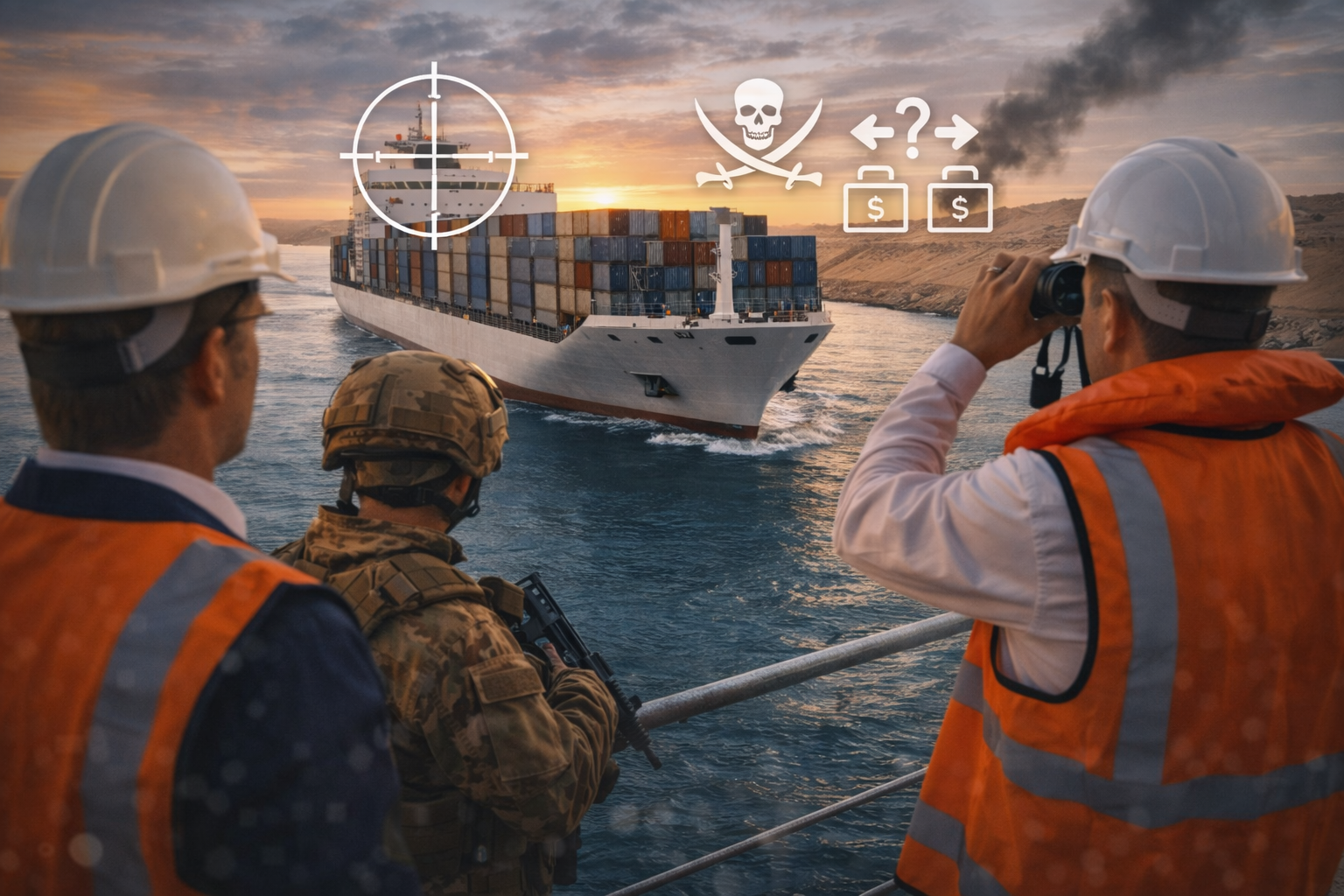
When headlines say “Red Sea re-opening” it can feel like a clean light switch moment, as if one announcement flips the entire shipping system back to normal overnight 🙂, but in reality the corridor behaves more like a dimmer switch with a lot of hands on it, because shipowners, insurers, charterers, navies, ports, and cargo owners all move at different speeds and with different incentives, and that is why the phrase “test voyage” matters so much: it is the industry’s way of admitting that normal is not back yet, while still probing whether a narrow, controlled slice of normal can be attempted safely, and in late 2025 this became very visible when Maersk conducted a controlled test transit with the vessel Maersk Sebarok while emphasizing that it was not a signal of an imminent network shift, but rather a safety assessment under strict protocols 🙂 (see the logistics market coverage: Kuehne+Nagel analysis on diverging reopenings and the controlled test voyage, and an industry safety writeup noting Maersk’s statement that no additional sailings were planned at the time: Safety4Sea on the Maersk Sebarok test voyage) 🙂.
What you’ll get here 🙂: clear definitions of what a “test voyage” really is and is not, why it matters for freight, insurance, and duty of care even if you never charter a ship, a practical framework to read signals without overreacting, a table that turns maritime buzzwords into business decisions, a diagram your team can screenshot, a realistic example, an anecdote style scenario that mirrors how companies actually get surprised, a metaphor that sticks without drama, a “personal experience” section written as a personal rule set you can adopt, plus 10 niche FAQs and a People Also Asked section that answers the exact questions people tend to ask right after they forward you a headline with two alarm emojis 😅📩.
1) Definitions: What a “Test Voyage” Actually Signals 🧩🙂
A test voyage is best understood as a controlled experiment inside a real world risk environment, where the company running the ship attempts a limited transit with unusually tight internal controls, unusually careful routing and timing, and unusually conservative decision thresholds, with the explicit goal of learning whether the threat environment, the reporting environment, and the operational environment are stable enough to justify either more transits or a broader network change, and the reason it is not the same as “re-opening” is simple: a single ship completing a passage is evidence that a passage can be completed, but it is not evidence that passages can be completed reliably, at scale, at predictable insurance pricing, and without unacceptable risk to crews 🙂.
In late 2025, that distinction became explicit because Maersk framed its move as testing conditions rather than shifting East West networks, and third party coverage emphasized that it was a controlled test voyage to assess conditions, which is a very different message than “we are back” 🙂 (see: Kuehne+Nagel writeup and Safety4Sea writeup) 🙂; if you read those two sources with a planner’s brain, what you hear is “we are willing to gather data again, but we are not promising routine operations.”
A second definition you need on your desk is threat environment vs. operational environment, because in the Red Sea context those are not identical: “threat environment” is the probability and nature of hostile actions, while “operational environment” includes the messy stuff that still causes incidents even without direct attacks, like GNSS interference, AIS anomalies, communication disruptions, and navigational confusion that increases collision risk, and this is not theoretical because UKMTO has repeatedly highlighted GNSS interference reports in the region, describing significant increases in reports during certain periods and noting associated AIS speed irregularities, which matters for safety even when no projectile is launched 🙂 (see: UKMTO Summary Report (Oct 2025) on GNSS interference and AIS anomalies, and UKMTO’s main advisory hub: UKMTO) 🙂.
The third definition is information environment, because in corridors like the Red Sea, risk is not only what happens, it is what you can verify in time to make decisions, and this is why organizations like the Joint Maritime Information Center exist, aiming to provide shipping companies with fused, unclassified information to support operational planning, and why their advisories and notes frequently emphasize both threat assessments and navigational hazards like electronic interference 🙂 (see: the official overview of JMIC’s purpose: Combined Maritime Forces on JMIC, and an example JMIC advisory note: JMIC Advisory Note (June 2025)) 🙂.
A simple translation 🙂: “Test voyage” usually means “we think the corridor might be passable under strict conditions, but we are not yet willing to bet our schedules, our crews, and our insurance pricing on it,” and if you plan logistics or budgets, that nuance is the difference between a smart adjustment and an expensive overreaction.
2) Why It’s Important: Because Real Risk Is Measured in Variance, Not Headlines 📉⚓🙂
The practical reason test voyages matter is that they are often the first visible sign that a risk premium might start to compress, but they are also a reminder that the premium may not disappear, because insurance pricing, routing decisions, and carrier capacity allocation depend on the expected distribution of outcomes, not on the best case outcome, and in an environment where electronic interference persists and where threat narratives can flare quickly, the variance remains the story even when one ship makes it through; this is why planners who treat a test voyage as “the end of disruption” often end up chasing their own forecasts, renegotiating contracts mid quarter, and explaining to leadership why “the return to normal” moved again 😅.
There is also a human reason, and it deserves a sentence on its own 🙂: every logistics decision in a high risk corridor includes seafarers who live the consequences, and when companies or customers talk about “re-openings” like a spreadsheet cell, crews often experience it as real anxiety, real fatigue, and real exposure, which is why even in JMIC and UKMTO guidance you see repeated emphasis on reporting, awareness, and the operational realities that can endanger vessels even without an overt attack; if you manage corporate duty of care, the “test voyage” is not only a cost signal, it is a reminder that safety governance is still active, not archived.
Here’s the metaphor that helps teams stop arguing in extremes 🙂: think of the Red Sea corridor like a bridge after a major storm 🌉, because one car driving across does not mean the bridge is “fine,” it means the bridge can support a car under certain conditions, and what you really need before you reroute your entire fleet is confidence about inspection standards, traffic control, weather patterns, and whether emergency services can respond, and in shipping terms that translates to verified threat reporting, stable navigational signals, insurer confidence, and a carrier’s willingness to publish routings rather than test them quietly.
3) How to Apply It: A Practical Framework for Reading “Test Voyage” Signals Without Getting Fooled 🧠✅🙂
The most useful way to interpret a test voyage is to run it through four questions that are simple enough to use in a real planning meeting but sharp enough to prevent wishful thinking 🙂: first, scope, meaning how limited was the test and what controls were used; second, repeatability, meaning whether there is evidence the transit can be repeated under similar conditions; third, insurance and contracting, meaning whether premiums, clauses, and coverage terms are shifting; and fourth, operational friction, meaning whether electronic interference, reporting complexity, and route management still create non attack risk that affects schedule reliability and safety.
On scope, you should look for explicit statements like “controlled test” and “not a signal of network shift,” because those phrases are not PR fluff, they are risk governance, and they tell you the company is still in data gathering mode, which is exactly how Maersk’s test voyage was characterized by third party logistics analysis and maritime safety coverage 🙂 (see: Kuehne+Nagel and Safety4Sea) 🙂.
On repeatability, you should watch for whether there are “no additional sailings planned” type statements or whether the carrier begins publishing routings and schedules through the corridor, because the moment a transit becomes schedulable it becomes a different kind of signal, and if you do not have that, you should treat a test voyage as information, not permission.
On insurance and contracting, the smart move is to ask whether your carrier quotes are changing and whether your contracts contain war risk, piracy, or deviation clauses that can reintroduce cost even if transit occurs, because in high risk areas the commercial “price of passage” often includes layered premiums and conditional terms, and test voyages sometimes precede renegotiations, not because everyone is greedy, but because insurers and underwriters need repeated, credible evidence to reprice risk.
On operational friction, you should treat GNSS interference as a first class planning variable, not a footnote, because it can create collisions, delays, and compliance issues, and UKMTO’s reporting on increased interference and AIS speed anomalies is a clear reminder that even if the threat of direct attack appears quiet, the navigational environment can remain degraded 🙂 (see: UKMTO Summary Report (Oct 2025)) 🙂; in plain terms, a corridor can be “less targeted” and still be “more dangerous” if ships cannot trust their navigation signals.
Table: “Test Voyage” Signal Decoder for 2026 Planning 📊🙂
| Signal you see | What it likely means | What a smart business does next | What a risky business does next 😅 |
|---|---|---|---|
| Carrier calls it a controlled test and says no network shift 🚢 | Data gathering, strict internal governance, limited exposure. | Model a “partial return” scenario, keep Cape routing as baseline until repeatability is proven, review contract clauses. | Assumes Suez is back, rewrites budgets, promises customers faster lead times immediately. |
| No follow up sailings announced 🗓️ | Uncertainty remains, insurer and security posture not ready for routine operations. | Maintain buffers and safety stock for critical lanes, negotiate flexible delivery windows. | Cuts buffer inventory too early and gets caught by the next deviation. |
| Persistent GNSS interference reports 🛰️ | Operational risk remains elevated even without kinetic events. | Ask carriers about navigation mitigations, adjust schedule risk assumptions, protect OTIF commitments. | Ignores it because it is not a dramatic “attack” headline. |
| Security advisories emphasize reporting and threat categorization 📡 | Information environment is active, risk picture can change quickly. | Subscribe to UKMTO and review JMIC notes as part of weekly risk cadence. | Relies on social media clips as a proxy for risk. |
| Freight and insurance quotes diverge by lane and cargo type 💼 | Market is selectively repricing risk, not normalizing broadly. | Segment planning by lane, cargo, and customer promise; avoid one size forecasts. | Uses one average rate for everything and gets surprised by exceptions. |
4) Examples: What a Test Voyage Changes and What It Does Not Change 🧾🙂
Imagine a consumer electronics importer planning Q1 and Q2 replenishment who has been routing via the Cape to protect schedule predictability, and then leadership forwards a headline saying “Red Sea re-openings” with a smiley emoji 🙂, and in that moment the disciplined response is not “switch back,” it is “update our scenario bands,” because a controlled test transit tells you that at least one operator judged conditions good enough for one carefully managed voyage, but it does not tell you whether the entire carrier network will return, whether insurers will reprice, or whether navigation interference will remain a safety and schedule factor, which UKMTO reporting suggests is still a live issue in parts of the region 🙂 (see: UKMTO Summary Report) 🙂.
In practical planning terms, the company should do three things at once, and yes it sounds like a lot but it is actually calmer than arguing in circles 😅: first, keep the baseline plan on the current routing until repeatability evidence emerges, second, build a partial return option for selected lanes or less time critical cargo with contractual flexibility, and third, renegotiate customer promise language so delivery dates are conditional on routing and security posture, because the real risk in this environment is not only “will a ship be attacked,” it is “will we be forced to deviate after we sold a promise we cannot keep.”
Here’s an anecdote style scenario that mirrors what shows up in post incident reviews 🙂: a team sees early positive signals, then a few customers demand faster lead times and the sales team agrees, then a deviation event occurs or advisories change, then the company either pays for emergency air freight or takes a reputational hit, and the painful part is that nobody made a stupid decision, they made a normal human decision based on incomplete evidence, which is exactly why “test voyage” should be treated as “one data point” rather than “the new truth.”
A “personal experience” you can adopt without needing anyone’s permission 🙂 is this simple personal rule: whenever you see a test voyage headline, you write down two sentences before you speak to anyone, sentence one is “what evidence changed,” sentence two is “what evidence did not change,” and then you force yourself to propose a conditional action like “we will consider partial return if we see repeated transits plus stable insurance terms plus no major increase in GNSS interference alerts,” because this tiny habit prevents you from converting a headline into a commitment, and commitments are where volatility charges interest 😅.
5) Conclusion: A Test Voyage Is a Signal to Upgrade Your Governance, Not a Signal to Relax It ✅🙂
The cleanest takeaway is that a test voyage is an information signal, not a normalization certificate, and the smartest companies use it to tighten their planning process rather than to simplify their story, because the moment risk starts to compress is often the moment teams are tempted to overpromise; if you treat test voyages as a prompt to refresh scenarios, review contract clauses, check navigational risk factors like GNSS interference, and align duty of care governance with reputable advisories such as UKMTO and JMIC, you can capture upside when conditions truly improve while avoiding the expensive whiplash of switching assumptions too fast 🙂 (see: UKMTO and JMIC overview) 🙂.
A sentence you can forward 🙂➡️: “A test voyage tells us the corridor might be passable under strict controls, so we will update scenarios and triggers, but we will not rebase budgets or customer promises until repeatability, insurance terms, and operational risks like GNSS interference show sustained improvement.”
FAQ: 10 Niche Questions About “Test Voyages” in the Red Sea and Suez Context 🤔🙂
2) What is the biggest mistake cargo owners make after a test voyage? Treating it as a green light to promise faster lead times before the carrier publishes routine routings and before contract terms and insurance pricing normalize, because you can end up paying for emergency alternatives when routing changes again.
3) Why does GNSS interference matter if the vessel is not being targeted? Because degraded navigation signals can raise collision risk and operational uncertainty, and UKMTO has documented periods with significant increases in GNSS interference reports and AIS anomalies in the region (see: UKMTO Summary Report (Oct 2025)).
4) How can we tell if a test voyage is “serious” or just PR? Look for language about strict safety protocols, controlled testing, and explicit statements that it does not indicate a network shift, which were emphasized in coverage of Maersk’s test transit (see: Safety4Sea and Kuehne+Nagel).
5) Should procurement renegotiate freight contracts right after a test voyage? It can be a good moment to add conditional flexibility, but it is usually too early to demand full normalization of rates, so a smarter approach is to negotiate review windows, contingency clauses, and transparency on war risk and deviation terms.
6) How do we incorporate test voyages into budget planning for 2026? Use scenario bands, meaning keep the diversion as baseline, model partial return as an upside case, and only shift the base case when repeatability evidence accumulates, because budgeting on a single optimistic path is what creates mid year margin surprises.
7) What should duty of care teams do differently when test voyages begin? Upgrade monitoring cadence and ensure security advisories and reporting channels are integrated into decision making, with UKMTO as a key reference point for merchant shipping reporting and alerts (see: UKMTO).
8) How does a test voyage affect insurance even if we are not the shipowner? Insurance costs feed into carrier pricing and can affect surcharge clauses, and even your own cargo insurance terms can be influenced by route risk, so you should ask for visibility into what is included in quotes.
9) Is a “quiet period” in advisories evidence the risk is gone? Not necessarily, because the information environment can change quickly and operational risks can remain, which is why organizations like JMIC exist to provide timely fused information for planning rather than relying on assumptions (see: JMIC overview).
10) What is a practical trigger for shifting from partial return to routine return? A reasonable trigger is a sustained period of repeated transits by multiple carriers, stable insurance and contract terms, and no major spike in navigation interference alerts, because routine return is about reliability, not one successful crossing 🙂.
People Also Asked: Real World Questions That Show Up Right After the Headline 🔎🙂
Why do some carriers return sooner than others? Differences in risk governance, fleet configuration, customer contracts, insurer appetite, and operational readiness can lead to divergent reopenings, which is why industry coverage can show different carriers moving at different speeds in the same period (see: Kuehne+Nagel analysis).
What should I ask my freight forwarder the moment a test voyage happens? Ask what routing policy carriers are actually offering, what war risk and deviation clauses apply, whether rates include conditional premiums, and whether there are active navigation interference concerns that could affect schedule reliability (UKMTO reporting is a useful reference point for the interference question: UKMTO Summary Report).
How do we avoid overreacting while still capturing upside? Use a two tier plan where the baseline stays conservative, but you pre approve partial return lanes with clear triggers and customer communication templates, because preparedness lets you move quickly without guessing.
What is the simplest indicator that “normalization” is actually happening? When routings become published and routine, multiple carriers sustain transits, and contract and insurance terms become predictable, because normalization is about repeatability and pricing stability, not about one brave voyage 🙂.
You should also read these…
- soturk.com – instagram location view feature discover tagged pl
- olddry.com – can ai actually be creative
- surgeblog.com – decoding luxury fabric names vicuna guanaco qiviut
- surgeblog.com – gut brain axis explained practical steps for mood
- noepic.com – reactions disappeared on facebook ui flags trigger
- closedad.com – tiktok running slow performance tips
- beofme.com – why are my tiktok videos less visible on for you
- surgeblog.com – twitter x domain blocked warnings security review
- olddry.com – why my tiktok videos arent on the for you page
- closedad.com – false bans wrongful account suspensions

