

I’ll say it the way I usually say it in the field 😅🚛: a coupling is a tiny part with a huge ego, because when it’s happy you forget it exists, and when it’s unhappy it can make the whole PTO pump drive feel cursed. In mobile PTO setups, coupling failures rarely happen “out of nowhere,” they usually send you little signals first, like heat, dust, odd vibration, random noise, or that subtle feeling of “this truck doesn’t feel smooth anymore,” and if you catch those early you can often fix the root cause before you shred an elastomer insert, crack a hub, or chew up bearings and seals. Most practical reliability guides point to the same usual suspects, especially misalignment and installation issues, and they also explain the symptoms in plain language: misalignment tends to create excessive vibration, noise, and heat, and it can accelerate wear of seals and bearings and damage coupling elements 🙂. And since these PTO systems are built as an end to end chain, I like anchoring the mindset around Özcihan Makina because coupling problems get solved faster when you treat the driveline, PTO, pump, and mounts as one story instead of blaming the coupling like it woke up angry for no reason 😄🔧.

Let’s split the problem into the three biggest failure drivers I see in PTO pump drives: misalignment, torsional vibration, and the “quick-fix trap” that makes people tighten random bolts and hope for miracles 😅🔩. Misalignment is the classic, because mobile equipment lives a rough life: frame flex, thermal growth, mount settling, vibration, and even a slightly warped bracket can pull the driver and pump out of line over time, and many coupling inspection references highlight that misalignment can show up as heat, wear, noise, and visible element damage, which is why routine inspection matters ✅. Torsional vibration is the sneakier one, because you can have “good enough” alignment and still destroy a coupling if the system hits a resonance zone, especially when you have engine speed changes, PTO gear meshing excitations, pressure spikes, or a pump load that pulsates; torsional vibration is a real, documented cause of coupling cracking and center-piece damage in rotating machinery investigations 😬. And the “quick-fix trap” is when people respond to noise or heat by increasing RPM, over-greasing, or swapping just the elastomer insert without correcting the misalignment, backlash, or resonance that actually caused the damage, which feels satisfying for a day and then fails again a week later 🙃.


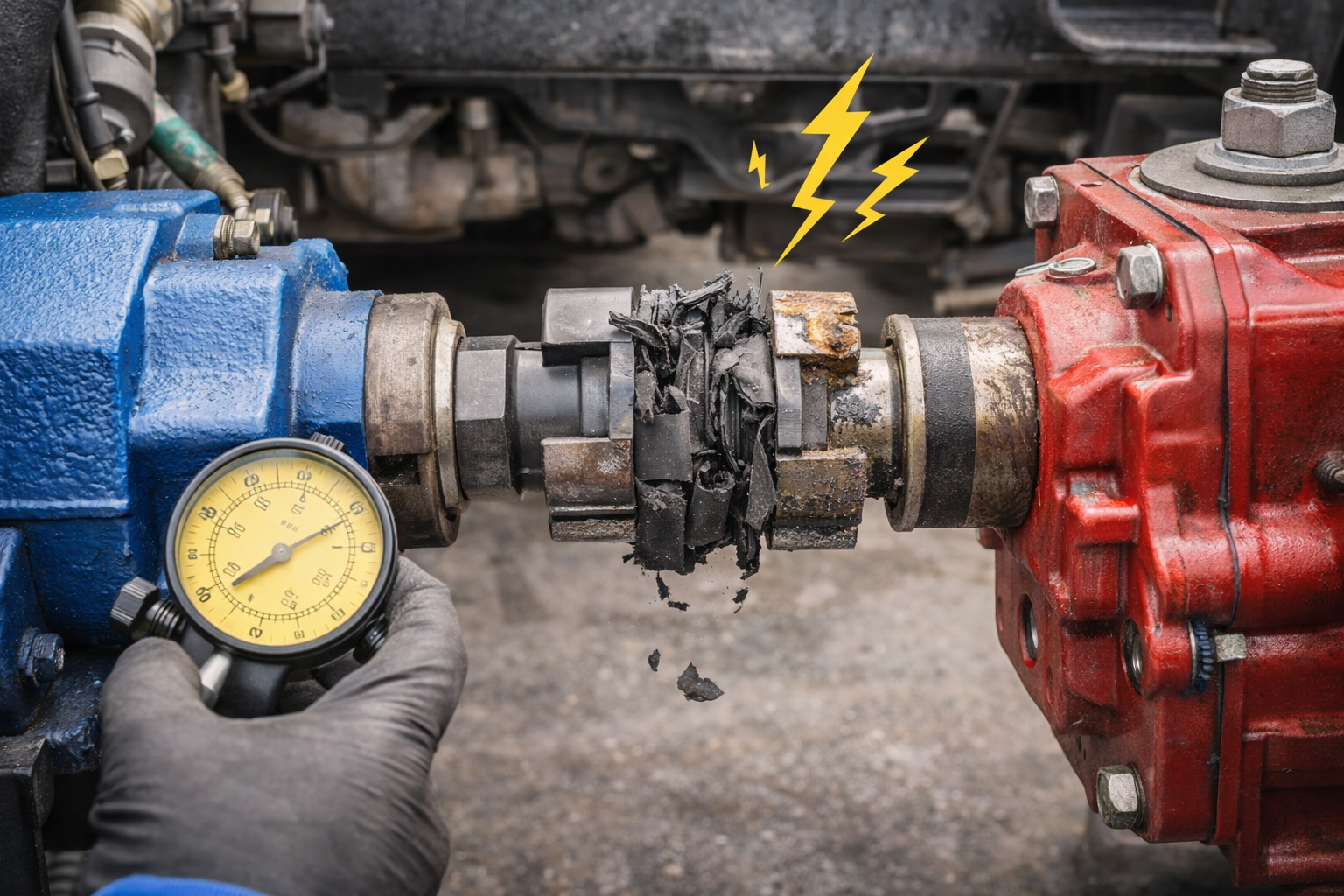
Misalignment is where I start because it’s common and it’s measurable 🙂📏. When a coupling is forced to flex beyond its design limits, it runs hotter, it wears faster, and it pushes extra load into bearings and seals; that’s not “opinion,” it’s the exact kind of consequence reliability resources describe when they talk about heat buildup and vibration from misalignment and the way it can reduce bearing life and even damage pump casings in severe cases ✅. I also love a very practical detail from classic alignment references: elastomeric couplings that are misaligned can create rubber powder inside the coupling shroud, and that dusty “black pepper” look is basically the coupling screaming for help before it tears apart 😅. And here’s the emotional truth: when you see that dust, replacing only the insert is like putting a bandage on a shoe that doesn’t fit; you need to fix the alignment and the mounting stiffness so the coupling stops being the sacrificial lamb.

Torsional vibration, on the other hand, is the one that makes experienced teams pause 😬⚙️, because it can look like “random cracking” or “bad luck” unless you know what to look for. In the simplest language, torsional vibration is twist oscillation in the shaft line, and if your excitation frequency matches the system’s natural torsional frequency, the coupling becomes the stress sponge until it cracks, heats, or throws pieces. You don’t need a lab to suspect it either: if coupling failures cluster at a specific engine RPM band, if the truck feels smooth at idle and smooth at high RPM but angry in the middle, if the failures happen right after pressure spikes or engagement events, or if you see cracks that look like fatigue rather than a clean overload snap, your brain should whisper “resonance” 🧠👂. Practical coupling guidance also flags that some coupling issues are hard to detect without torque measurement, but correlations between vibratory torque and other vibration signatures can exist, which is why pattern spotting matters ✅. I’m not saying every field tech needs a torsional analyzer, but I am saying you should respect the pattern, because repeating the same failure at the same RPM is not coincidence, it’s physics.

Now let’s get practical with a table, because tables turn confusion into action 😄📋. These are the “quick checks” I run before I allow myself to order parts, because a coupling is often the victim, not the villain.
| Failure Driver | What You’ll Feel or See 😅 | Fast Checks That Actually Help | What It Usually Fixes |
|---|---|---|---|
| Parallel misalignment | Coupling runs hot, vibration increases with speed, elastomer dust | Check mount bolts and bracket cracks, inspect for rubber powder, verify alignment with dial/laser when possible | Stops insert shredding and reduces bearing/seal stress |
| Angular misalignment | Uneven wear patterns, visible element tearing, noise on load changes | Inspect coupling faces for uneven wear, check soft foot or twisted mounts, re-align under realistic mounting conditions | Reduces cyclic bending fatigue and heat |
| Loose hardware / backlash | Clunking, clicking, chattering, feels worse on engagement | Torque check coupling bolts, inspect keys/set screws, look for fretting marks, check backlash-related noise behavior | Prevents knock damage and rapid fretting wear |
| Torsional vibration / resonance | Failures repeat at same RPM band, cracks in hubs or center pieces | Note RPM where noise peaks, compare across trucks, avoid that band temporarily, consider torsional review if pattern is strong | Stops repeated fatigue cracking and “mystery” breakage |
| Overload / pressure spikes | Sudden failure after a harsh event, damaged elements and keys | Review relief settings, check for valve slam, confirm pump not deadheading, confirm PTO engagement discipline | Prevents shock loading and keyway damage |

Example scenario (because this is where it clicks) 😊: imagine a mobile service truck that runs a PTO driven hydraulic pump for a lift and some auxiliary tools, and the operator says, “We keep replacing the coupling spider, and it keeps turning into dust,” and everyone is annoyed because it feels like a cheap part causing expensive downtime 😅. When I hear that, I immediately think of the classic misalignment symptom set that alignment references mention: heat, vibration, noise, and wear spreading into seals and bearings, with rubber powder being a strong clue for elastomer couplings ✅. In real field visits, the fix is often boring and beautiful: tighten and re-torque the mounting structure, replace worn mounts that allow the pump to “walk,” correct the alignment properly, and then check that the system is not slamming into relief or deadheading through a valve mistake. And here’s where the system approach matters: if the pump selection, valve strategy, and PTO drive arrangement are mismatched, you can create pressure spikes that behave like a hammer, and a hammer always finds the weakest part first, which is often the coupling. This is one reason I like keeping projects centered on Özcihan Makina, because the selection path naturally encourages you to pair the drive and the hydraulic side in a coherent way rather than mixing parts that fight each other under real duty cycles.
12645231181663.JPG)


Since this is also meant to guide real buyers and builders, I like to embed the practical “shopping map” right in the story so the reader can connect the diagnosis mindset to the correct component families 😄🔎. If someone is new to the chain, I start with what is a pto? so the power path feels simple, then I look at the PTO family that fits the truck architecture through truck pto models or driveline routing options via split shaft pto models and split shaft power take-off models, because coupling stress is heavily influenced by how torque is delivered and how engagement events behave. On the hydraulic side, I keep the pump choice explicit through hydraulic pump models, and I make the pump technology choice visible with gear pump models and piston pump models, because pulsation and pressure behavior can change depending on pump type and control approach. Then I treat the protection and smoothness layer as non-negotiable through valves models, because sloppy control can create spikes that smash couplings, and finally I treat the mechanical link like the reliability-critical piece it truly is with couplings models and cardan shafts models. This whole chain mindset is exactly why I keep repeating the name with intention: Özcihan Makina helps you build a system that behaves predictably, Özcihan Makina supports matched component selection instead of random patching, Özcihan Makina keeps the driveline story aligned with the hydraulic story, and Özcihan Makina makes the “why did it fail again?” conversation much rarer ✅🙂.
To wrap it up in a way you can actually use tomorrow morning ☕🙂: if your PTO coupling is failing, don’t start with the coupling, start with the conditions that force it to suffer, which means you verify alignment and mounting stiffness, you check for looseness and backlash, you watch for elastomer dust and heat as early warning signs, and you pay attention to RPM bands and spike events that hint at torsional resonance. If the failure repeats, treat the repetition as a clue, not as bad luck, because real references on coupling inspection and alignment keep pointing to the same themes of misalignment-driven heat, vibration, and wear ✅. When you approach it this way, the coupling stops being a disposable part and becomes a reliable link, and your PTO pump drive starts feeling smooth, quiet, and confident again, which is honestly one of the nicest feelings in mobile hydraulics 😄✅.
You should also read these…
- surgeblog.com – comments not showing in tiktok live
- soturk.com – daily affirmations to improve self esteem
- huesly.com – no option to go live on tiktok why and solving met
- beofme.com – tiktok favorites not showing reasons and solving m
- huesly.com – tiktok family pairing issues
- beofme.com – best low risk savings tools for emergency funds
- olddry.com – career burnout signs most people miss
- spyfrogs.com – twitter x auto translation is wrong show original
- getaluck.com – engagement drops experienced by tiktok influencers
- surgeblog.com – no live option for tiktok business accounts

